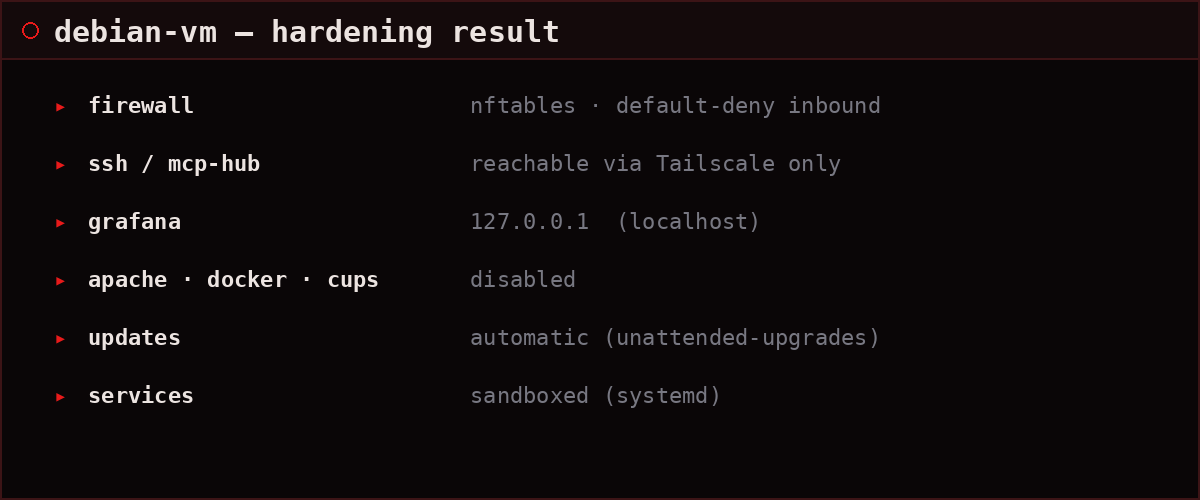
Terminal summary of the VM hardening result

Hardening My Debian Home-Lab VM — Even Behind pfSense

My Debian automation VM already sits behind a pfSense firewall with egress containment — it can reach the internet but not my home network. So why harden the VM itself? Because “behind a firewall” is doing less work than it sounds. Two paths reach into the VM without ever crossing pfSense, and an honest audit of my own box turned up drift I didn’t expect. This is the write-up: what the audit found, what I changed, and the systemd sandbox mistake that quietly broke a service. ...

7 July 2026
The Spec Grabber HTML report

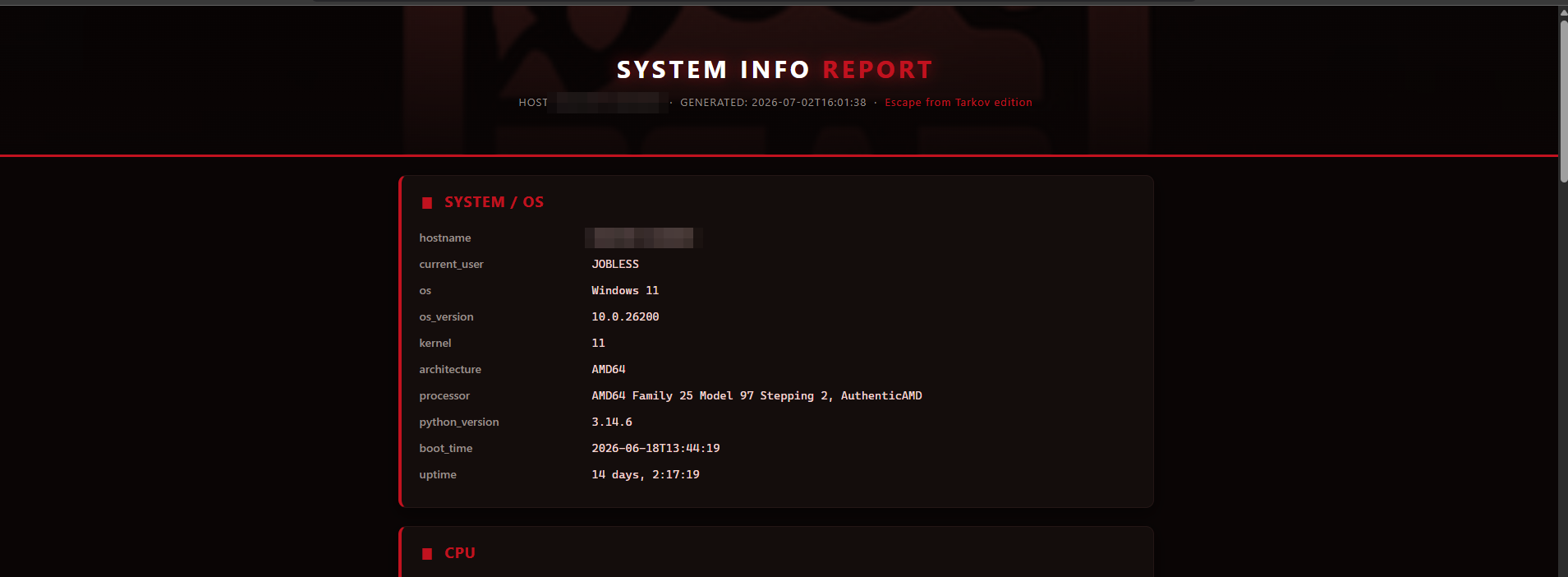
Created a SystemInfo Grabber Program with Claude AI

I wanted a small desktop tool that captures a snapshot of a machine — hardware, resource usage, network state — and writes it to a styled HTML report viewable in any browser. Useful for quick system audits and for keeping a record of a machine’s specs over time. I built it in one Claude Code session (Opus 4.8) on my Debian 13 laptop, then packaged it for Windows as well. ...

2 July 2026
Arcadyan HWG2025 router

Hardening and Segmenting My Home Network on an Arcadyan HWG2025

This is a small home network — one router, a handful of devices. The point wasn’t complexity; it was applying the same discipline you would to a small office or lab environment. Treated that way, it doubles as practical study for Network+ and Security+. The router is an Arcadyan HWG2025 — the NBN-issued unit, Wi-Fi 7 with MLO, around 500 Mb down. An ISP router doesn’t give you much room to move, but it gives you enough to do this properly. ...

29 June 2026
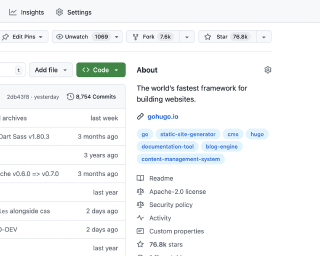
The Hugo blog running on GitHub Pages

Self-Hosting a Hugo Blog with a Claude Code Publishing Pipeline

The blog you’re reading was published by the pipeline this post describes. Why Hugo, and why self-hosted I needed somewhere to document real technical work — networking, security, mod projects — that I could point to from LinkedIn. Hosted platforms were out: no content ownership, paywall friction, someone else’s branding. Hugo won on attack surface. It’s a single Go binary — no Node, no node_modules, no npm dependency tree to patch and audit. For a security portfolio, the blog itself should be as defensible as the work it documents. It builds to plain static files, so serving is trivial; the trade-off is owning uptime and patching, which for this use case is a feature. ...

29 June 2026