A network digital twin: does my homelab still look the way I think it does?

With the SOC built and an AI analyst sitting on top of it, the obvious gap was that both of them only knew about things that happened. Neither knew what my lab was supposed to look like in the first place. So this project builds a baseline — a structured representation of the homelab, physical and logical — and then continuously checks reality against it. If a port opens that I know nothing about, I want to find out because it disagreed with the inventory, not because I happened to look. ...
10 September 2026 · 9 min

Integrating Kimi as a read-only AI security analyst for my homelab SOC

With the new SOC structure and dashboard built, I decided to take on a bigger project: integrating Kimi as a security AI analyst. Its role covers reporting on alerts, examining logs, judging whether something is a false positive, and auditing continuously. It is built in phases, and each phase needs extensive validation before the next one starts. The problem The SOC we built catches things. Seven log sources into Loki, 36 detection rules, alerts routed to my phone by severity, one Grafana dashboard over all of it. ...

8 September 2026 · 10 min

A SOC for the homelab, built in the right order

My homelab keeps growing — more containers, more services, a multi-LLM setup on top. Security is the priority for all of it: guard rails, hooks, and strict policies everywhere, to the point that my main Claude agent is audited by Codex, with Kimi as a third read-only reviewer I invoke manually through the council dashboard. What it didn’t have was a place to see any of that. So: a SOC. A centralised security view for the lab, and a genuinely useful thing to have built. ...

6 September 2026 · 10 min
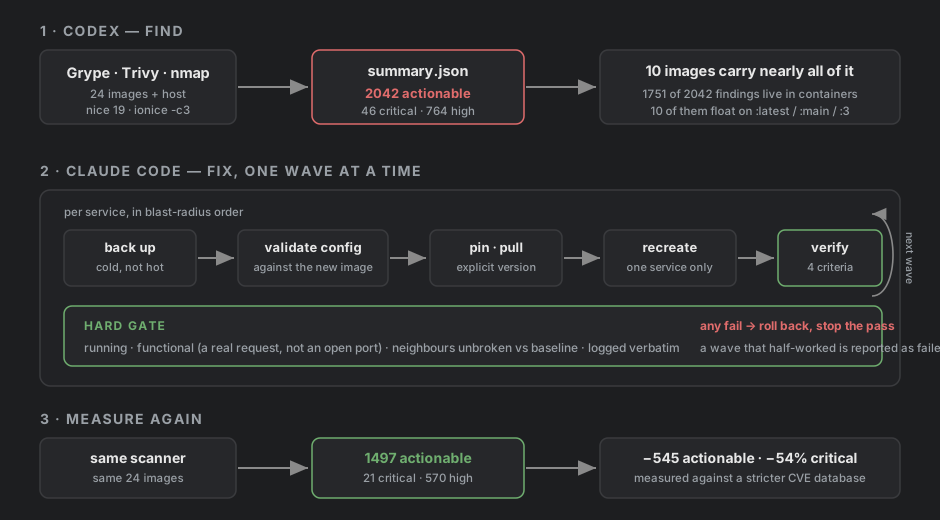
Pipeline diagram: Codex scans 24 images and finds 2042 actionable findings, Claude Code fixes them one wave at a time behind a hard validation gate, then the same scanner measures again at 1497

A Vulnerability Scan From Codex, a Container Upgrade From Claude Code

I run two coding agents against this lab. Codex found the problem and Claude Code fixed it, and keeping those two jobs in different hands turned out to be the most useful part of the whole exercise. The short version: a full vulnerability scan reported 2042 actionable findings — 46 critical, 764 high — and 1751 of them were in container images. Ten waves of updates later, the same scanner reports 1497 actionable, 21 critical, 570 high. ...

18 August 2026 · 10 min
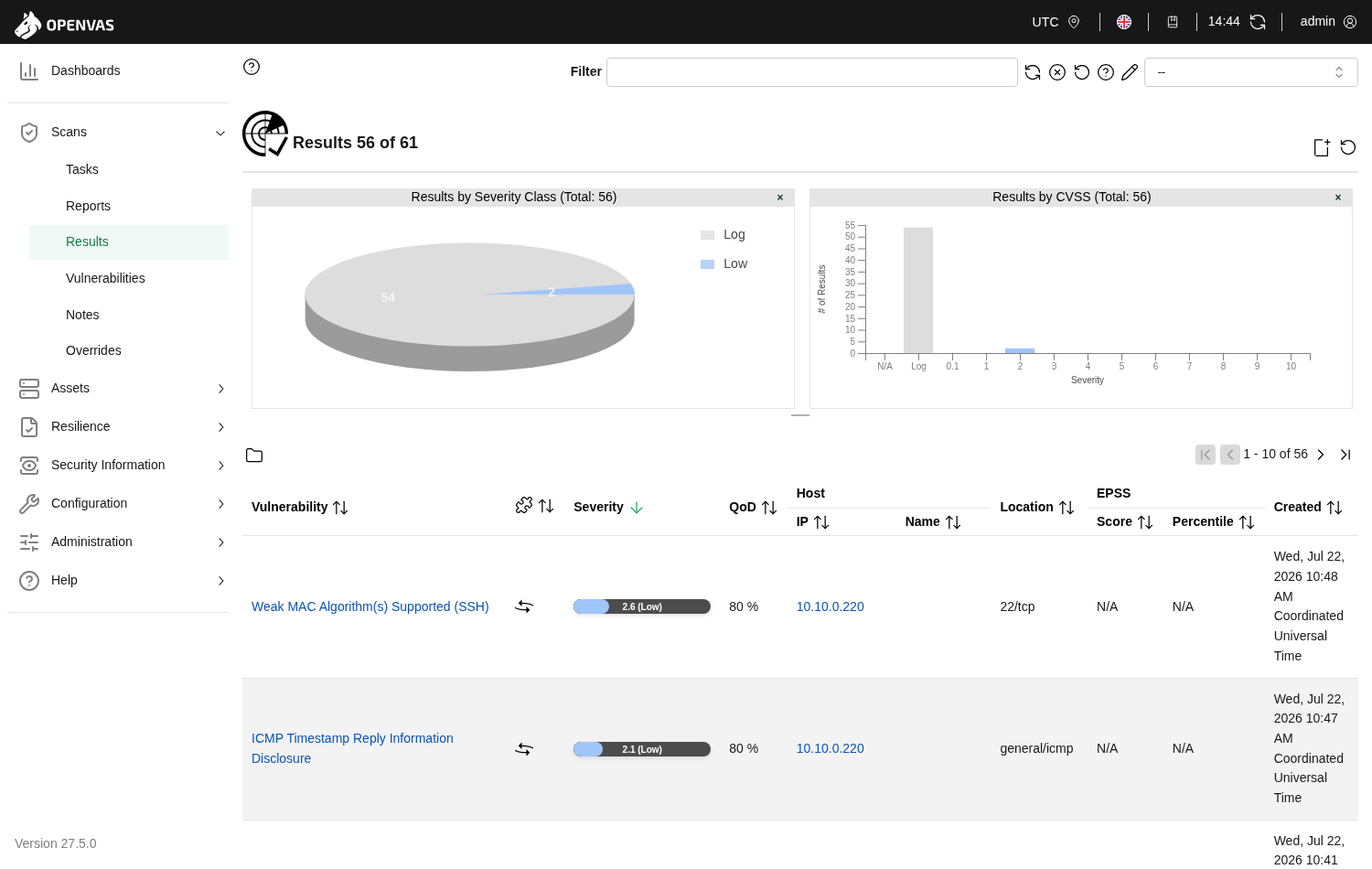
OpenVAS results page showing the first scan's findings by severity

Running OpenVAS in My Home Lab — Install, the Three Things That Broke, and the First Scan

I wanted a real vulnerability scanner in the lab — something that port-scans a host, throws a big pile of network vulnerability tests at it, and tells me what to fix by severity. OpenVAS (now Greenbone Community Edition) is the obvious choice, and it ships as a Docker stack. This is the honest write-up: the install, the three separate things that broke, one of which was my own fault, and what the scanner actually found when I pointed it at my own box. Nothing here is polished — I got a couple of things wrong along the way and I’m leaving those in, because that’s where the useful bits are. ...

22 July 2026 · 11 min