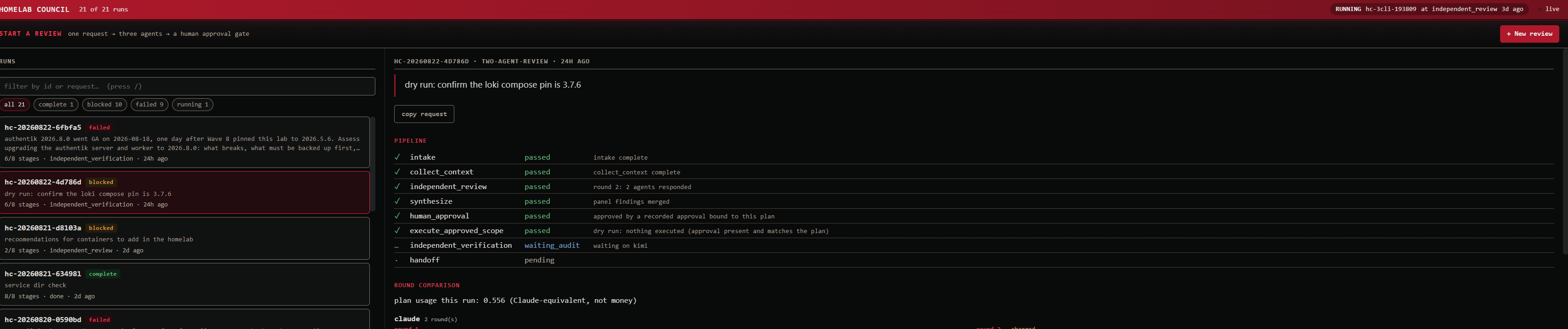
The council dashboard showing a run's pipeline, all stages passed through the approval gate

The Council Gets a Front Door

The council worked. One request went to Claude, Codex and Kimi, they answered independently, and nothing touched the lab without a human approval bound to a hash of the exact plan. It also lived entirely in a terminal, which meant that to approve a run I had to type a run id like hc-20260822-6fbfa5 and then re-type the original 350-character request verbatim, because resume rebuilds the context pack from it. Get one character wrong and you have quietly changed the inputs the agents were judged on. ...
23 August 2026 · 7 min
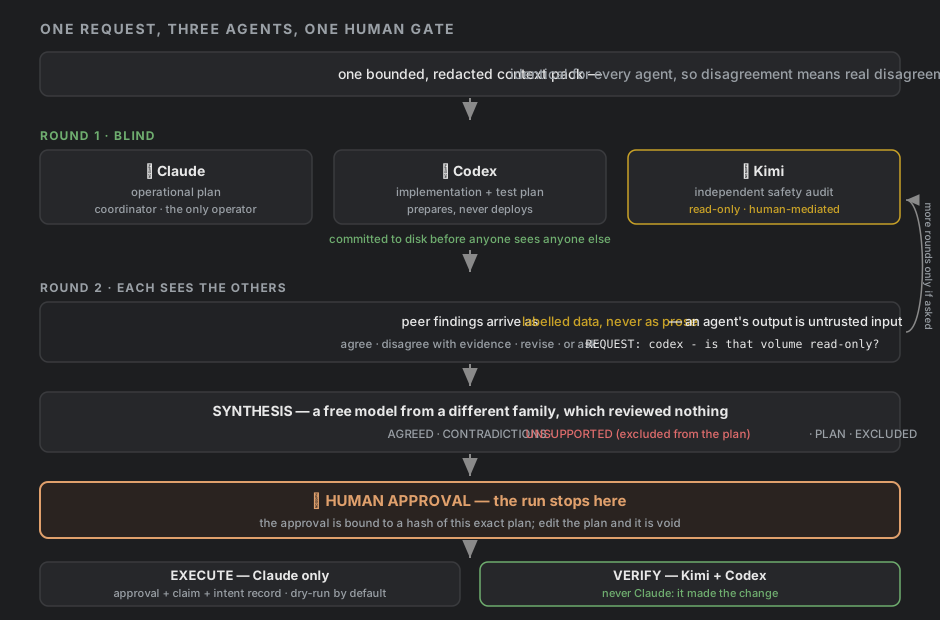
Pipeline diagram: one context pack fans out to Claude, Codex and Kimi in a blind first round, then a peer round, then a free model synthesises, then a human approval gate, then execute and verify

Three Agents, One Approval Gate — Making Claude, Codex and Kimi Review Each Other

I have three coding agents with access to this lab. Claude Code does most of the building. Codex reviews and runs the scans. Kimi audits. Until this week they had never exchanged a word — each got its own context, its own session, and its own chance to be confidently wrong with nobody checking. So I built a thing that makes them work one request together, and put a human approval gate in front of anything that changes the lab. ...

19 August 2026 · 11 min
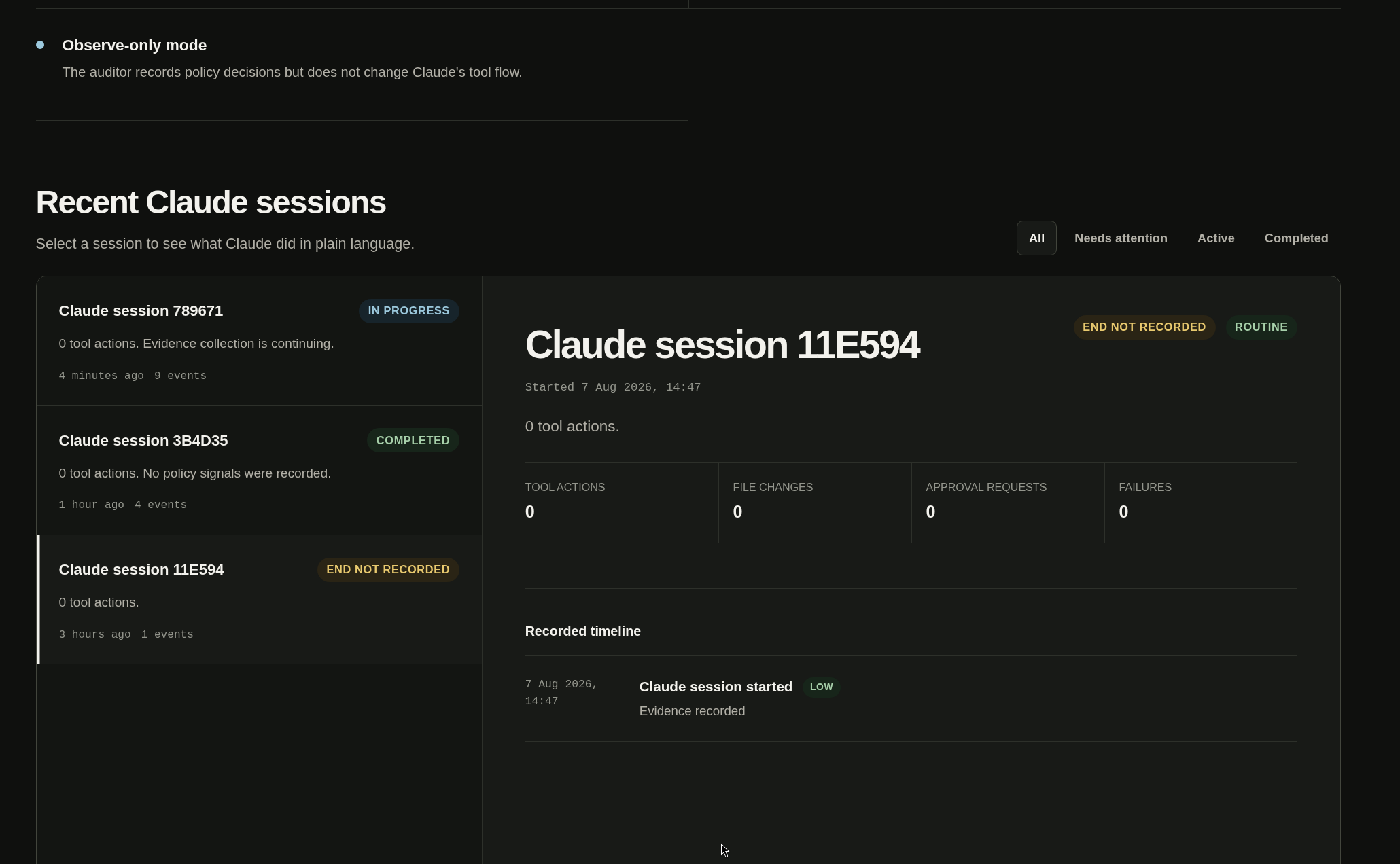
The agent auditor's local operator dashboard, showing observe-only mode and a list of recent Claude sessions with their recorded timelines

Auditing the AI Agent That Runs My Homelab

My homelab has picked up a lot of moving parts this year, and several of them are now LLMs. Claude Code runs natively on the box and does real work against real infrastructure — containers, reverse proxy config, monitoring, the lot. That’s genuinely useful. It also creates a trust problem I hadn’t had before. The problem is simple to state: the same agent that makes a change also writes the summary explaining why the change was safe. That’s convenient. It is not independent verification. If the agent quietly skips a validator and then reports “config validated”, I have no signal at all. The report is the evidence, and the thing that wrote the report is the thing being checked. ...

7 August 2026 · 9 min
RAINBOW MATRIX cover — the post title in rainbow monospace over falling matrix rain on black

A Self-Hosted Multi-LLM Gateway for My Homelab

Claude Code is the main LLM running my homelab. It builds, debugs, and documents most of what happens on the Debian VM. But I wanted to try other models — and give the CLI tools a shared backend — without wiring up a different SDK and API key for every provider. So I put a gateway in front: one endpoint, many models. Claude stays the main driver; everything else is now one config line away. ...

29 July 2026 · 5 min
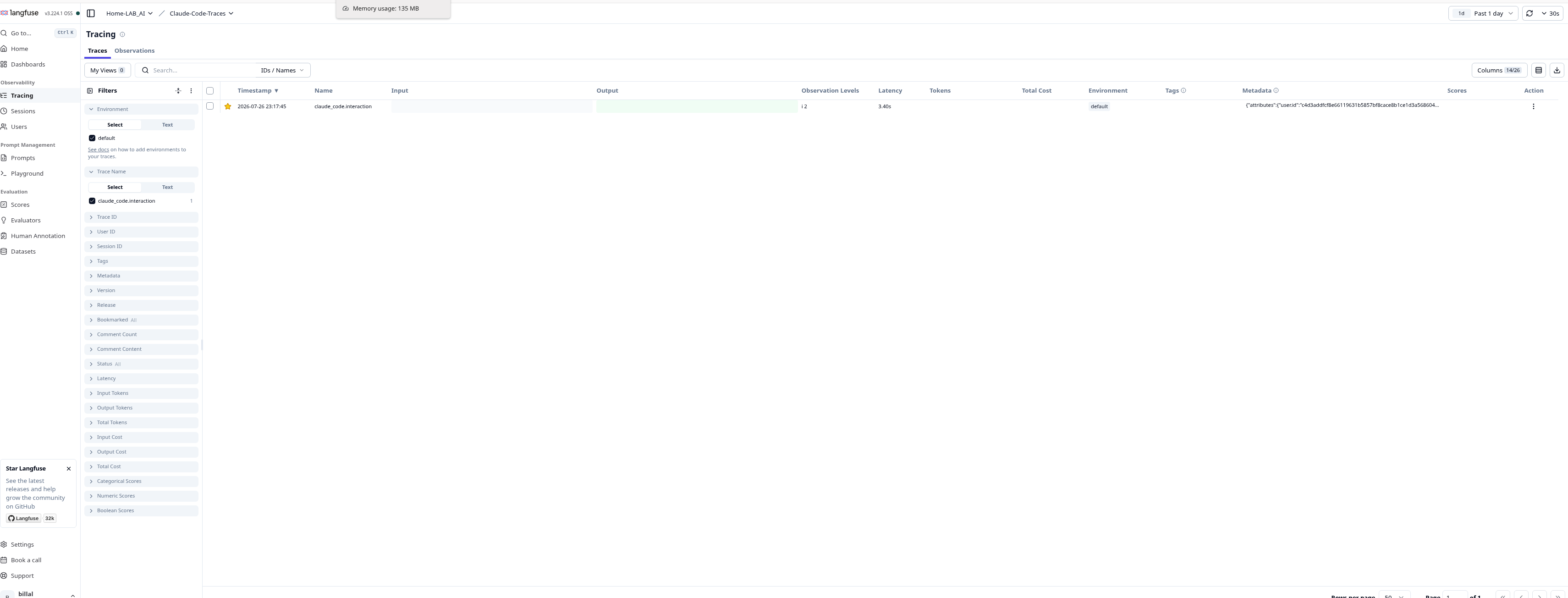
Langfuse's Tracing view showing a single claude_code.interaction trace with 2 observations and 3.40s latency

Implementing Langfuse to Monitor Claude Code

We all tend to focus on the output of whatever LLM we’re using — did it get the answer right, was it fast, was it useful. What I’d stopped paying attention to was the background: how many tokens a session was actually burning, where they went, and whether I’d have any way of knowing if something had gone quietly wrong. Claude Code runs natively on my homelab now, doing real work against real infrastructure, and I wanted more than “the output looked fine” as my only signal. ...

27 July 2026 · 4 min
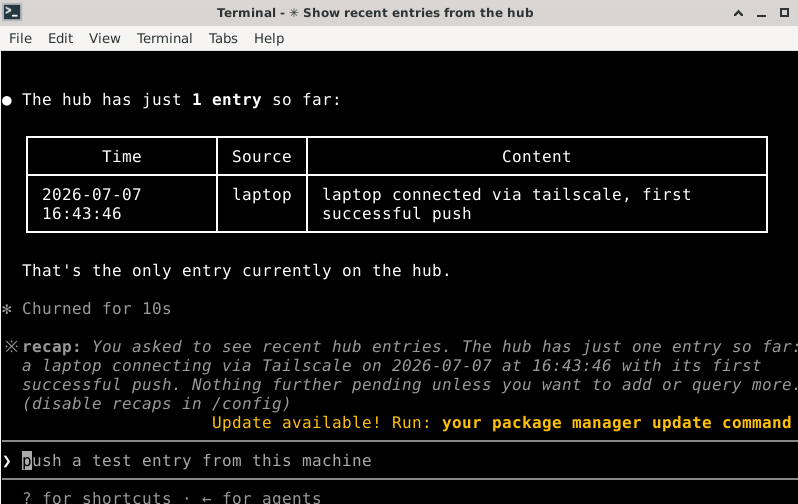
A note pushed from the laptop appearing on the hub via get_recent

Syncing Claude Code Across Devices with a Custom MCP Hub over Tailscale

I run Claude Code on two machines: the Debian VM in my home lab (always on) and a Debian laptop (sleeps, roams, follows me to campus). I wanted the laptop to push notes, facts, and findings into a central store on the VM — from any network — so the home-lab agent could pick them up later. Claude Code’s built-in Remote Control turns a second device into a remote window onto one session. That’s not what I wanted. I wanted both machines to stay fully independent agents, linked through a shared tool. So I built a small MCP server on the VM and pointed the laptop’s Claude Code at it: the hub becomes just another tool the laptop can call. ...

7 July 2026 · 6 min