The blog you’re reading changed builders. The git push that publishes it is
identical; what runs on the other end isn’t. It used to be a GitHub Actions job
that built the site and served it from yourlocalunemployed.github.io. Now
Cloudflare Pages builds from the same repo and serves it at
billalrehmani.pages.dev.
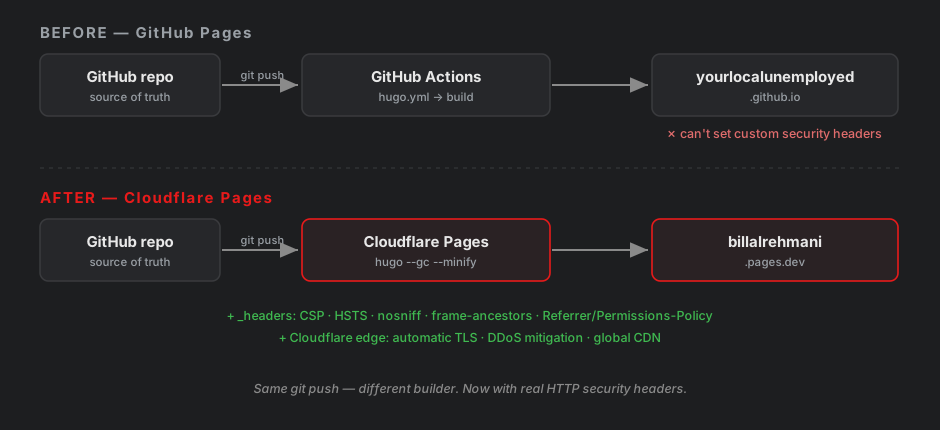
I didn’t move for speed or for a nicer dashboard. I moved because GitHub Pages won’t let me set HTTP response headers, and for a blog that’s meant to be a security portfolio, that was the one limit I couldn’t design around.
The actual problem: a meta tag is not response headers
On GitHub Pages the only place I could express a Content-Security-Policy was a
<meta http-equiv> tag in the page <head>:
<meta http-equiv="Content-Security-Policy" content="default-src 'self'; script-src 'self' 'unsafe-inline' https://giscus.app; ...; base-uri 'self'; form-action 'self';">
That works for the directives a meta tag is allowed to carry. The problem is the
ones it isn’t. Browsers ignore frame-ancestors, report-uri, and
sandbox when the CSP arrives via <meta> — they’re only honoured as a real
response header. So the directive that actually stops my pages being framed for
clickjacking was silently doing nothing.
And that’s just CSP. A whole set of security headers can only exist as response headers — there is no meta equivalent at all:
Strict-Transport-Security(HSTS)X-Content-Type-Options: nosniffX-Frame-OptionsPermissions-PolicyCross-Origin-Opener-Policy
On GitHub Pages, none of those were being sent. There’s no setting for it — Pages doesn’t expose custom response headers, full stop. My security posture was capped at whatever a meta tag could say, and a meta tag can’t say most of it.
Cloudflare Pages reads a _headers file and turns it into real response
headers. That single capability is the whole reason for the move.
The _headers file
Hugo copies anything in static/ verbatim into public/, so
static/_headers lands at the site root where Cloudflare looks for it:
/*
  Content-Security-Policy: default-src 'self'; script-src 'self' 'unsafe-inline' https://giscus.app; style-src 'self' 'unsafe-inline' https://giscus.app; font-src 'self'; img-src 'self' data: https://avatars.githubusercontent.com; connect-src 'self' https://giscus.app; frame-src https://giscus.app; base-uri 'self'; form-action 'self'; object-src 'none'; frame-ancestors 'none'
  Strict-Transport-Security: max-age=31536000
  X-Content-Type-Options: nosniff
  X-Frame-Options: DENY
  Referrer-Policy: strict-origin-when-cross-origin
  Permissions-Policy: camera=(), microphone=(), geolocation=(), payment=(), usb=()
  X-XSS-Protection: 0
  Cross-Origin-Opener-Policy: same-origin
The /* matches every route. Note the two directives the meta version couldn’t
enforce are back and doing real work now: object-src 'none' and
frame-ancestors 'none'.
I kept the <meta> CSP in the template as a fallback — it still applies during
local hugo server preview, where nothing is serving a _headers file. The two
have to stay in sync by hand, so there’s a comment at the top of _headers
saying exactly that, plus a reminder that if I ever wire up GoatCounter
analytics I have to add its origins to the CSP in both files. Duplicated
config is a liability; the least I can do is leave a note next to both copies.
Pointing Hugo at the new URL
baseURL has to match wherever the site actually lives, or every absolute link
and the RSS feed point at the old host:
baseURL = "https://billalrehmani.pages.dev/"
The build config that isn’t in the repo
Cloudflare Pages’ build settings live in its dashboard, not in a file in the
repo, which caught me out for a minute — there’s nothing to git blame if it
breaks. For the record:
- Build command:
hugo --gc --minify - Output directory:
public - Environment:
HUGO_VERSION = 0.163.3(the extended build)
Two things worth knowing. Pin HUGO_VERSION — Cloudflare’s default Hugo is old,
and a version mismatch against what I run locally is exactly the kind of “works
on my machine” gap I don’t want in a build I can’t see. And the extended build
is fine here specifically because PaperMod ships plain CSS: no Dart Sass in the
toolchain to install or break. The theme is a git submodule, and Cloudflare
clones the repo recursively, so it comes down on its own — no extra step.
Retiring the old pipeline
For a short window both pipelines were live, which meant every push
double-deployed: GitHub Actions rebuilt github.io and Cloudflare rebuilt
pages.dev. Two copies of the site from one push is confusing and pointless, so
I deleted the workflow:
git rm .github/workflows/hugo.yml
That’s the whole retirement. With no workflow file, GitHub Actions has nothing to run, and a push now only reaches Cloudflare.
One manual step is left that can’t be done from the repo: GitHub → Settings →
Pages → Source: None, to take the stale github.io copy offline. Deleting the
Action stops new builds; it doesn’t unpublish what Pages already served.
Checking it actually worked
The point of the whole exercise was response headers, so that’s what I verified — straight from the command line, filtered down to the ones I care about:
curl -sI https://billalrehmani.pages.dev | grep -Ei 'content-security|strict-transport|x-frame|x-content|referrer|permissions'
Seeing strict-transport-security, x-frame-options, and the full CSP come back
as actual headers — not as a meta tag the browser half-honours — is the
difference the move was for. securityheaders.com
tells the same story more legibly if you’d rather see a grade than read raw
headers.
What I traded
Nothing about the writing workflow changed — it’s still notes in the repo,
/newpost, review, git push. What changed underneath:
- Gained: real security headers, plus Cloudflare’s edge for free — automatic TLS, a global CDN, and DDoS mitigation I don’t have to think about.
- Cost: the publish path now runs through both GitHub and Cloudflare, so both accounts hold 2FA and both matter. That’s a slightly wider blast radius than “just GitHub” — a fair trade for headers I couldn’t get any other way.
public/ is still committed to the repo, which is now redundant since Cloudflare
rebuilds it from source on every push. It’s harmless, so I’ve left it; pruning it
is a cleanup for another day, not a blocker.
Same git push. Different builder. This time the site tells the browser how to
protect it.