I now hand finished write-ups to a second Claude that owns this repository, instead of publishing them myself. It turns a draft into a post and keeps the standing pages honest. Before any of that could run, something had to stop a draft carrying a credential or a real address into a public repo.
That is this post. The gate works. Getting there was mostly me rebuilding, in the gate itself, the exact failure the gate exists to catch.
The rule that decides the design
Anything pushed here is permanent. GitHub serves branch content, not just
main, so a leak on a draft branch is public the moment it lands and deleting
the branch afterwards retracts nothing. Two screenshots in this repo were
redacted in a later commit and the originals are still one git show away.
So redaction happens before the push. The gate is the second line, and it fails closed: a crash, a malformed config, an unreadable image all exit non-zero. The Claude Code hooks in this repo all fail open on purpose, because an assistant that blocks your work when its own code breaks is worse than no assistant. This is not an assistant. A control that fails open is a label.
Thirty-one findings, all wrong
First run against the existing posts:
31 findings
Every single one a false positive. The interesting ones:
An SNMP OID is not an IP address. A naive dotted-quad regex carves
1.3.6.1.2.1.31.1.1.1.1 into two plausible public addresses. The d="..."
path data behind an SVG icon yields three more — coordinate pairs separated by
dots. Fixed by requiring that no dot or digit sits on either side of a match,
because a real address is never embedded in a longer dotted run.
A correct redaction got rejected. Posts here replace the real dynamic-DNS
hostname with mylab.duckdns.org. An exact-match comparison then flagged
auth.mylab.duckdns.org — a subdomain of the placeholder, which is exactly
what the rule wants to see.
A reference to a secret is not a secret. api_key: os.environ/OPENROUTER_API_KEY
is LiteLLM’s own syntax, and the gate read it as a 29-character credential.
Same for ${VAR}, !secret, ${{ secrets.X }}.
A redacted URI read as entropy. /?access_token=REDACTED&since=0&limit=50
gave a 48-character “value” spanning the whole query string, and that mixture
passed a character-variety test. An ampersand now ends a value.
None of that is subtle once you see it. The point is that a gate producing 31 false positives gets commented out inside a week, and then you have no gate plus a memory of having one. A third of the test suite is now things that must not fire.
The gate would have been the leak
This repo is public, so its Actions logs are public. The first version printed the credential it matched, into a log anyone can read. The gate would have published the secret it caught.
Credential findings now report the rule, the file, the line and the length — never the match. There is a test asserting it, including on the error path, because an error message is exactly where a withheld value escapes by accident.
Address findings still print in full, on the opposite argument: by the time the gate fires on a pushed branch, that address is already public, and you cannot redact what you cannot see.
Then it started lying to me
Some patterns are specific to my lab and can’t live in a public repo, so they go in a gitignored file locally and a repository secret in CI. Two copies, nothing keeping them in sync, neither reviewable.
The template I wrote for that file shipped every example commented out with a capitalised stand-in. I uncommented a line and did not replace the stand-in.
leak gate: clean (320 tracked files scanned, 1 site pattern(s))
One pattern loaded. The “no patterns configured” note gone. Clean scan. The
pattern was \bPUT-YOUR-REAL-LABEL-HERE\b and it matched nothing, because
that string appears nowhere in my blog. Every visible signal said working.
Then CI failed for three runs while local passed, because the secret still held an older copy. It was only caught because the stale value happened to be invalid. An empty one would have sailed through and reported clean.
And the worst one, found by the second agent reviewing my work:
$ python3 scripts/leak-gate.py /nonexistent/fake.md
leak gate: clean (320 tracked files scanned...)
Exit 0. It discarded the argument entirely and scanned the whole repo instead. A clean result for a file it never opened — and the documented workflow is to run exactly that before pushing.
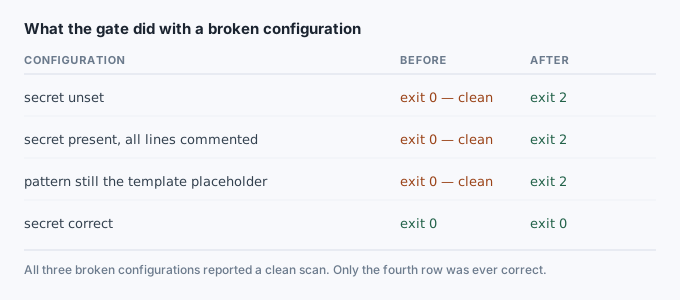
Every one of those is the same bug: a check that is not running finds nothing, and finding nothing looks identical to finding nothing wrong. It is the vulnerability scanner from a fortnight ago reporting zero open ports because it was scanning an address that no longer existed.
What actually fixed it
Not more rules. Invariants that make silence impossible:
- A committed file declares how many lab-specific patterns must load. Fewer than declared is a refusal, not a pass. That one line closes the way a stale or empty secret could fail open.
- A pattern that is still a template placeholder is refused at load, by name and by shape.
- A pattern matching a value the contract mandates — the documentation address, the placeholder hostname — is refused, because it would fail correct content and leave no way through. The check is structural: strip the regex furniture and ask whether what remains is a private or documentation address. My first attempt was a list of specific strings and it missed one address because the list contained a neighbour of it.
- A bad path or unknown argument exits 2. Silently accepting an argument is how a scanner comes to report on files it never read.
- The planted-leak tests run in CI before the gate, so every run re-proves the thing can still fail.
That last one matters most. 87 tests, and about a third of them are content and configuration that must pass. A gate that cannot fail is worse than no gate, so the suite has to demonstrate failure on demand, not just absence of findings.
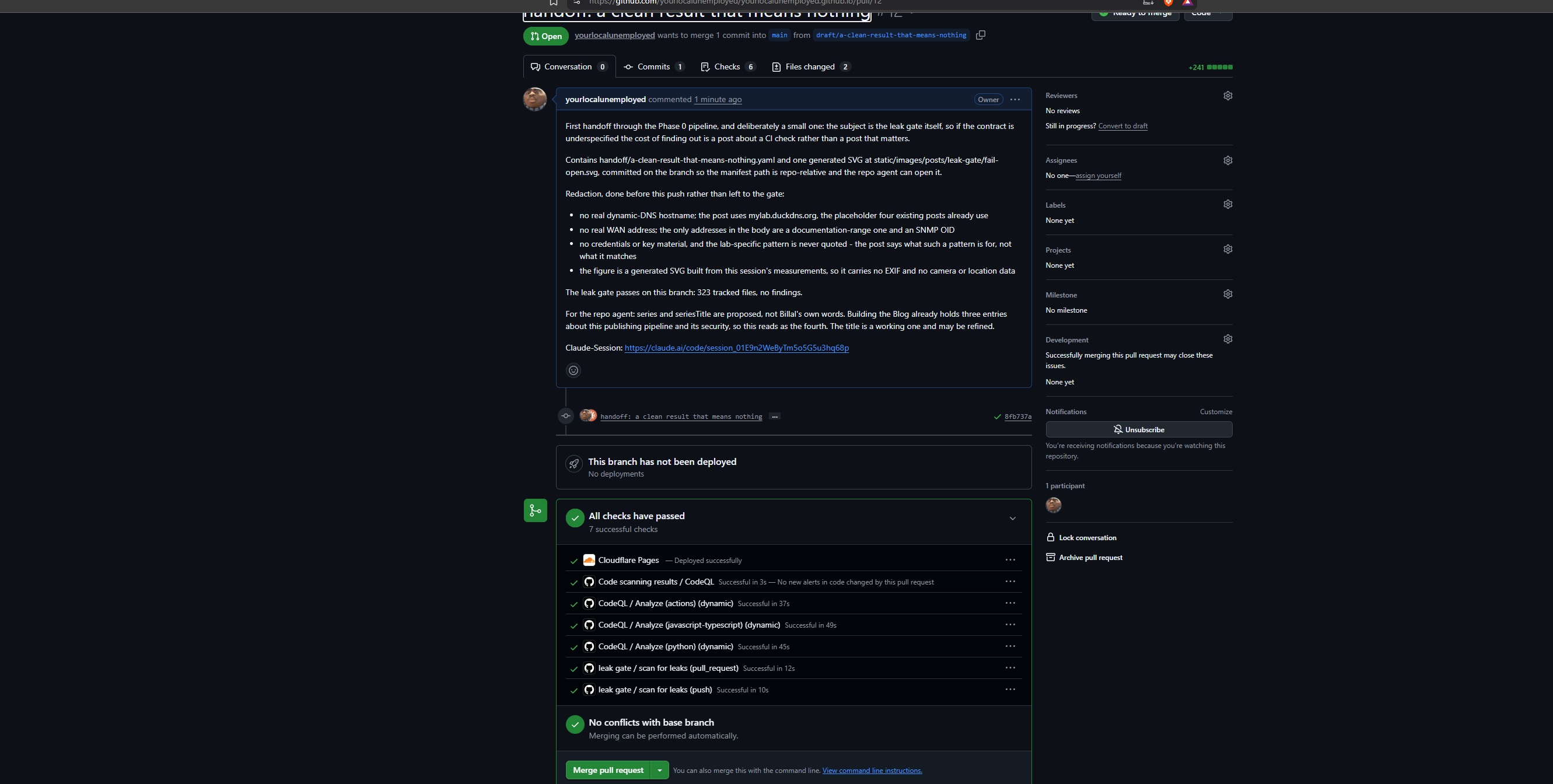
The gate appears twice in that list — once for the branch push, once for the pull request. The push run is the one that matters. By the time a pull request exists the branch has been public for however long it took someone to open it.
What it still can’t do
Written down, because an undocumented limit reads as coverage:
- A leak drawn in pixels is invisible. There is no OCR. The image rule only reads metadata, so a screenshot showing a token passes every check. Masking a port column while the service names stay visible beside it is the specific trap — SSH is 22 whether or not you blur it.
- It scans the tree, not the history. A leak committed and then corrected on the same branch is still served at the earlier commit.
- It enforces the pattern count, not the content. A hash would catch that, but a hash of a short pattern on a public repo is brute-forceable.
The part I keep thinking about
Writing the documentation for this tripped the gate three separate times — the OID fragments, the coordinate run, and a public IPv6 address quoted as an example. Each time the honest fix was to reword rather than add a suppression marker, because an inline bypass anyone can apply to any line is worth more to an attacker than to an author.
But the thing I did not expect is how hard it is to tell a working check from one that has quietly stopped. Every failure here produced output that looked like success. The clean scan, the loaded pattern, the passing CI run, the exit code zero — all technically true, all meaningless.
The fix was never a better regex. It was deciding what the gate must refuse to do, and making it refuse loudly.